Stay Cool, Save Energy: Business Air Conditioning
30th June 2026

As the UK enters the summer season, exceptionally hot weather as experienced in June 2026 is something we may encounter more regularly should the rising global temperatures not be slowed down. NetRegs has asked Arthian to provide this insights article exploring energy compliance and good practice areas for businesses impacted by the warmer weather.
Air conditioning can be essential for comfort, productivity and, in many buildings, safe operation. But for large businesses, it is also one of the most overlooked sources of energy waste. As Energy Engineers we regularly see systems left running longer than required, maintained reactively rather than proactively, or controlled in ways that increase costs without improving comfort.
Arthian’s Energy team include mechanical and electrical Engineers providing services called “TM44” Air Conditioning inspections across the UK. Technical Memorandum 44 (TM44) was developed by the Chartered Institution of Building Services Engineering (CIBSE) and although it is a legal requirement for businesses, the TM44 report can provide important information to help businesses maintain their air conditioning equipment and help with overall performance – saving carbon, energy and money.
Improving air conditioning performance does not have to be an expensive process; in many cases, businesses can reduce consumption, maintain equipment and stay compliant with just a few changes to daily life. Our tips to maintain and run air conditioning equipment efficiently are provided below.
As refrigerant gases are used in all cooling equipment and there have been many changes to the regulations and refrigerant types, Arthian have also provided a breakdown of the current refrigerant and F-Gas regulation, identified the business benefits and finally provided tips from our Compliance Team for ‘how to’ stay in compliance with the regulations.
Tips to maintain and run air conditioning equipment efficiently.
Businesses can often make meaningful improvements by focusing on simple, practical actions:
- Review operating hours so air conditioning only runs when areas are occupied or genuinely need temperature control.
- Check temperature setpoints (the bandwidth of the lowest and highest temperatures) and avoid overcooling; small setpoint changes can reduce energy use without affecting comfort.
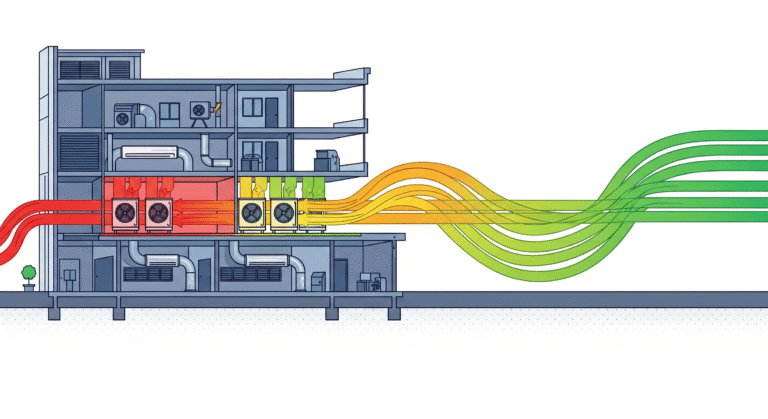
- Prevent heating and cooling systems from working against each other – this one is a classic energy audit finding – avoid having heating and cooling systems in the same physical space.
- Clean or replace filters regularly to maintain airflow and reduce pressure on fans and compressors.
- Keep indoor and outdoor coils clean so the system can transfer heat efficiently.
- Make sure outdoor units have clear airflow and are not blocked by debris, storage or vegetation.
- Check that sensors and thermostats are correctly located and not affected by draughts, sunlight or nearby heat sources.
- Monitor refrigerant containing systems; monitor for leaks and keep service records up to date, especially for systems containing F-Gases.
- Review energy data, comfort complaints and maintenance history together to identify recurring issues.
- Use blinds/ shutters where possible to reduce solar gain of the areas you are trying to keep cool.
- Building users can be apprehensive to adjust temperatures to suit them, and pleasing everyone is almost impossible! Staff training and notices should be on display if air conditioning systems can be locally adjusted; communication is key! Alternatively use building set-points only – but communicate this and how individuals can ask for changes.
- Avoid the common mistake of setting the temperature to the lowest or highest temperature available. The unit will need to work extremely hard to meet this temperature and often never will, increasing costs. Set the temperature to a realistic target and the outcome will be more cost effective and reach the desired temperature just as quick.

Latest Refrigerant and F-Gas Regulations
It is important for businesses to be up to date with the latest regulations for F-Gases. Fluorinated gases are referred to as F-gases and have a high global warming potential (GWP). If F-gases escape into the atmosphere, your business will be contributing to the acceleration of climate change. This is why they are regulated.
Here are the key points for businesses to be aware of:
- Regulation around refrigerant gases is changing, which is important when planning new air conditioning installations, maintenance strategies and future replacement budgets.
- UK F-Gas guidance applies to organisations that use, service, produce, import, export or sell equipment containing fluorinated greenhouse gases, including refrigeration and air conditioning systems.
- From 01 January 2025, new single-split air conditioning systems placed on the market in the UK must not contain less than 3kg of F-Gases using refrigerants with a GWP of 750 or more.
- This affects higher-GWP refrigerants historically used in some air conditioning systems, such as R410A and R407C, and supports the move towards lower-GWP alternatives.
- For existing systems, businesses should understand what refrigerant is in use, whether leak-checking and service records are complete, and how future availability or cost of higher-GWP refrigerants could affect maintenance.
- Any work involving F-Gases should be carried out by appropriately certified, competent contractors, with refrigerant recovery, leak prevention and record keeping treated as part of normal asset management.
- TM44 inspections and practical air conditioning reviews can help identify opportunities for improvement, especially with older systems, high-GWP refrigerants, poor controls, leakage risk and replacement priorities before they become urgent, expensive or disruptive.

Business benefits from TM44 air conditioning inspections
Air conditioning equipment will need a TM44 air conditioning inspection every 5 years from installation or the last inspection, if the total cooling capacity exceeds 12kW. This applies to every organisation in the UK – there is no separation of compliance obligations for SME or large organisations as there is for other energy-related regulations such as ESOS (the Energy Savings Opportunity Scheme).
A TM44 inspection gives businesses a structured way to understand how well air conditioning systems are performing. Rather than it only being a compliance exercise, it can highlight practical opportunities to improve efficiency, reduce unnecessary energy use and keep equipment operating more reliably.
The main benefits include:
- Improved legal compliance for qualifying systems, helping building owners, occupiers and managers meet their inspection responsibilities.
- Clear recommendations on how to reduce energy consumption, running costs and carbon emissions – saving your business money and supporting your net zero carbon plans.
- Identification of poor controls, incorrect time schedules, unsuitable setpoints and simultaneous heating and cooling.
- Evidence of whether equipment is appropriately sized for the building and how it is currently used.
- Early visibility of maintenance issues that may be affecting performance, comfort or reliability.
- Better information for planning future upgrades, replacement budgets and decarbonisation strategies.
- An up to date, clear asset list will be provided for the business to use.
Arthian tips on staying compliant with F-Gas Legislation
Air conditioning systems containing F-Gases are subject to legal requirements that go beyond routine servicing and maintenance. Businesses should understand their F-Gas compliance obligations, maintain accurate records, and ensure systems are being managed in accordance with current legislation. Taking a proactive approach will help businesses remain compliant while supporting effective asset management and planning for future regulatory changes.
Arthian’s Environmental Legal Compliance Team can support businesses by:
- Identifying gaps through environmental legal compliance audits;
- Reviewing maintenance records, leak testing documentation, and other statutory records to verify compliance;
- Reviewing F-Gas compliance requirements for air conditioning and other F-Gas containing assets (e.g. chillers);
- Developing F-Gas equipment registers that provide a central record of equipment, refrigerant type and volumes, and statutory compliance requirements; and
- Providing practical advice to support ongoing compliance and future regulatory changes.
Contact EHS Compliance Lead Jill Cottrell at jill.cottrell@arthian.com for more information on compliance auditing and Bryan.McAlpine@arthian.com for more information on Energy Audits, TM44 practical checks, and related engineering projects.
This article was written at the invitation of NetRegs — environmental guidance for businesses in Northern Ireland and Scotland, a partnership of the Northern Ireland Environment Agency (NIEA) and of the Scottish Environment Protection Agency (SEPA).