Energy

10th April 2026

An Air Quality Assessment is the assessment of ambient external air quality at a proposed development and/or the impact of a proposed development on air quality.
Due to the potential impact of high air pollution concentrations and the legislation governing it, air quality should be considered at an early stage.
Used by local authorities and respective stakeholders, Air Quality Assessments are used to determine whether a development will either cause significant effects on the local area through increased emissions or if poor air quality will affect future building occupiers.
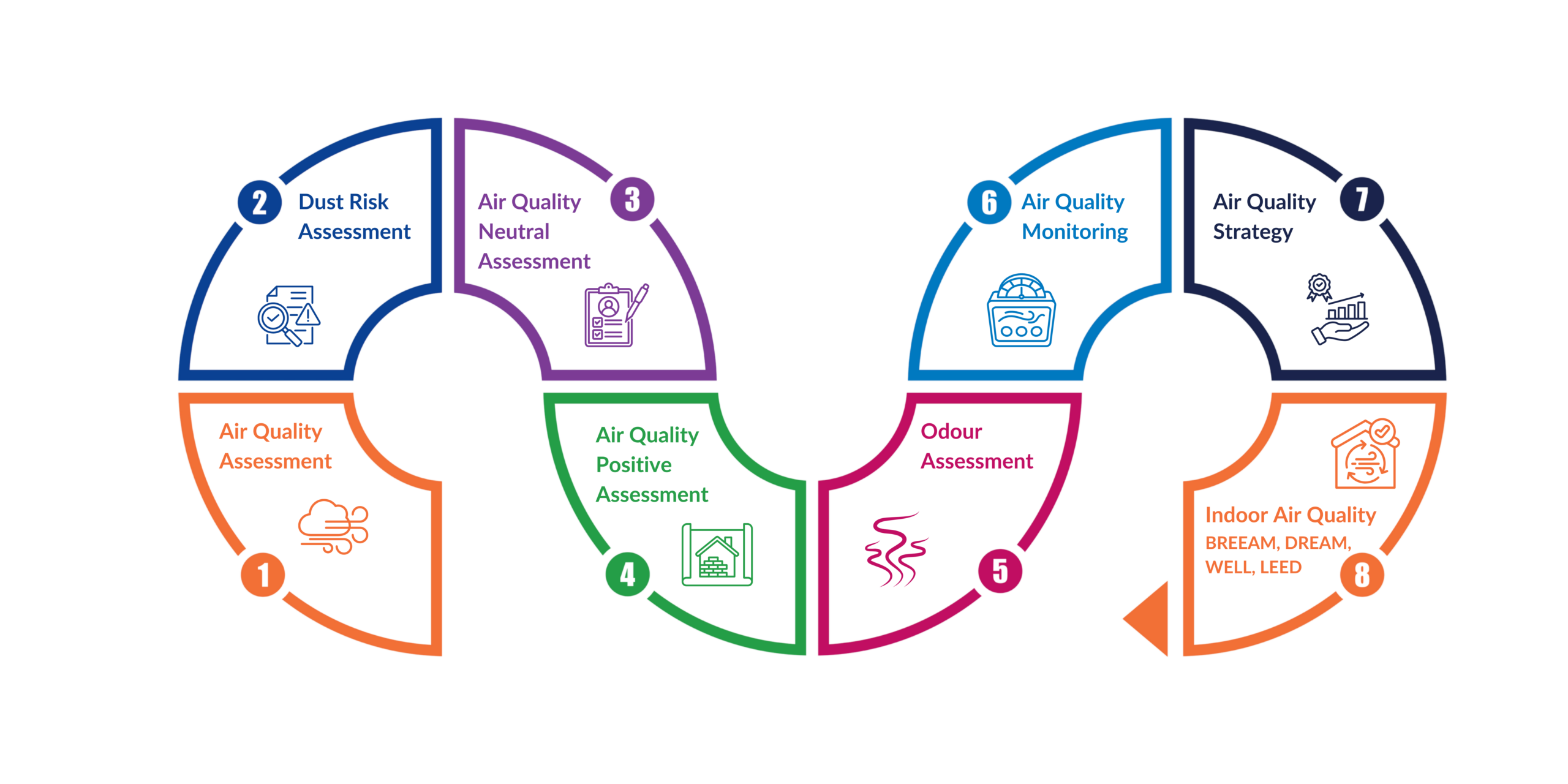
There are various types of air quality assessment required depending on the size, location and future use of the development. Whilst there are a variety of terms used to describe these assessments, some of these are as follows:
Air Quality Assessment
Air Quality Assessments involve using software to model transport and fixed point emission sources on nearby sensitive receptors in the opening year of the proposed development. This will also determine whether air quality is below the required regulations.
Dust Risk Assessment
Dust Risk Assessments are a desk based assessment which evaluate the potential risk of nuisance dust to the nearby receptors.
Air Quality Neutral Assessment
In London, it is a requirement for developments over a certain size to assess the building and transport emissions against a prescribed benchmark which set out the maximum allowed emissions of NOx and particulate matter.
Air Quality Positive Assessment
As part of The London Plan, development classified as “major” are required to be accompanied with an Air Quality Positive Statement.
Odour Assessment
There are multiple types of odour assessment varying from on site “sniff tests” to desk based risk assessments and dispersion models. All assessments have the aim to assess and minimise the potential for odour nuisance in the local area.
Air Quality Monitoring
There are multiple types of air quality monitoring which are dependant on the requirement. Often monitoring can be undertaken during the demolition/construction phase as part of the wider NVD package.
Air Quality Strategy
An Air Quality Strategy is often required where a form of mitigation measures are required to offset the significant effects of a development on the wider area or where existing air quality is above the respective objects.
Indoor Air Quality for BREEAM, DREAM, WELL or Lead
There is a plethora of sustainability schemes that require air quality assessments and testing to form part of the wider submission. BREEAM Hea 02/05 contains credits which require plans and testing to obtain these credits.

UK air quality law is a mix of primary legislation, regulations and planning policy to form the overarching framework. The Air Quality Standards Regulations 2010 and Environment Act 2021 provides legally binding limits for concentrations of all major air pollutants that impact public health. Local Air Quality Management, National Planning Policy Framework (NPPF) and Environmental Permitting Regulations provide mechanisms of enforcement of these values. As mentioned above regional policy documents such as the GLA’s London Plan and regional strategies such as the West Yorkshire Low Emissions Strategy provide policy and guidance for new development.
Typically an Air Quality Assessment is required when a proposed development could affect local air quality or be affected by existing poor quality. It is a consideration across the RIBA plan ranging from strategic definition and site suitability to detailed design.
An Air Quality Assessment can be used to inform the layout and design of the building, the assessment of air quality should be seen as an iterative process which is constantly updated and helps guide the development design.

Under the NPPF new developments should not worsen air quality, be appropriate for its location and the cumulative impact should be assessed. Air Quality is a material planning consideration with local authorities having a duty to review and assess air quality within their boundary. Often an air quality assessment is a requirement for the validation of a planning application and so required at an early stage. Where the information required for an assessment is not available at the time of planning submission, an assessment can be required as a recommencement planning condition to be discharged.
At Arthian, we have over 35 years of experience in air quality modelling and assessments.
By working with Arthian as your strategic partners, we can support you with any air quality issues you may have.